
Beyond the Picket Fence
4 Surprising Truths About Life in a Modern Tennessee Suburb

Introduction: The Modern Suburb is Not What You Think
When you picture American suburban life, a familiar, often monolithic, image comes to mind: manicured lawns, identical houses, and a certain cultural uniformity. It’s a stereotype that has been reinforced for decades. But beneath the surface, demographic data can reveal a story that is far more complex, diverse, and fascinating.By looking closely at the numbers, we can see how these communities are evolving in unexpected ways. To understand this shift, we're taking a deep dive into one specific area, Gallatin, Tennessee, zip code 37066, as a case study. The data from this rapidly growing community dismantles old clichés and provides a new blueprint for what a modern American suburb can be.
This Isn't Just Growth; It's a Population Boom
1. It’s Not Just Growing, It’s Booming.The first and most impactful fact about Gallatin is its staggering rate of growth. While many areas see modest increases, the 37066 zip code is experiencing a genuine population boom. Since 2020, its population has surged by an incredible 14.25% .To put that number in perspective, the growth rate for the surrounding Sumner County during the same period was 8.06%, and for the entire state of Tennessee, it was just 4.25%. Gallatin's growth isn't just outpacing its neighbors; it's more than triple the rate of the state as a whole. This rapid influx of people has tangible effects, creating not just opportunity but also the infrastructure demands of a boomtown, with daily traffic counts on key arteries like SR386 exceeding 44,000 vehicles. This is the picture of a community in motion, driven by new residents drawn to its promise, particularly its newer neighborhoods, where 65% of the homes for its dominant demographic were built after 1990.But who are all these new people flocking to Gallatin? The answer is far from the suburban stereotype.
An Unexpected "Urban" Vibe is Thriving
2. You’ll Find an Unexpected Pocket of “Urban” Culture.Demographic analysis uses consumer segmentation to identify the different lifestyle "tribes" that coexist in a single community. What’s truly remarkable here is the discovery of a group you would expect to find in a dense city center. This segment, known as "Emerald City," makes up nearly 15% (14.9%) of all households in the area.The characteristics of the Emerald City group are distinctly urban. They are young, mobile professionals who are more likely to rent, embrace a "foodie" culture with a preference for organic and environmentally friendly products, and are often liberal supporters of NPR and PBS.Emerald City’s denizens live in lower-density neighborhoods of urban areas throughout the country. Young and mobile, they are more likely to rent. Half have a college degree and a professional occupation.Finding this group in a Tennessee suburb is surprising. But the sheer scale of their presence is genuinely stunning. Nationally, the "Emerald City" segment accounts for only 1.4% of all U.S. households. This means Gallatin has a concentration of this archetypal "urbanite" that is more than ten times the national average . This trend is likely fueled by a combination of remote work flexibility and a search for urban amenities without the price tag of a major metropolitan core. This points to a fundamental reshaping of what suburban life can look like.This influx of young professionals brings a new cultural flavor, but they're settling into a community with deep, and economically diverse, local roots.
A Stark Mix of Affluence and Working-Class Roots
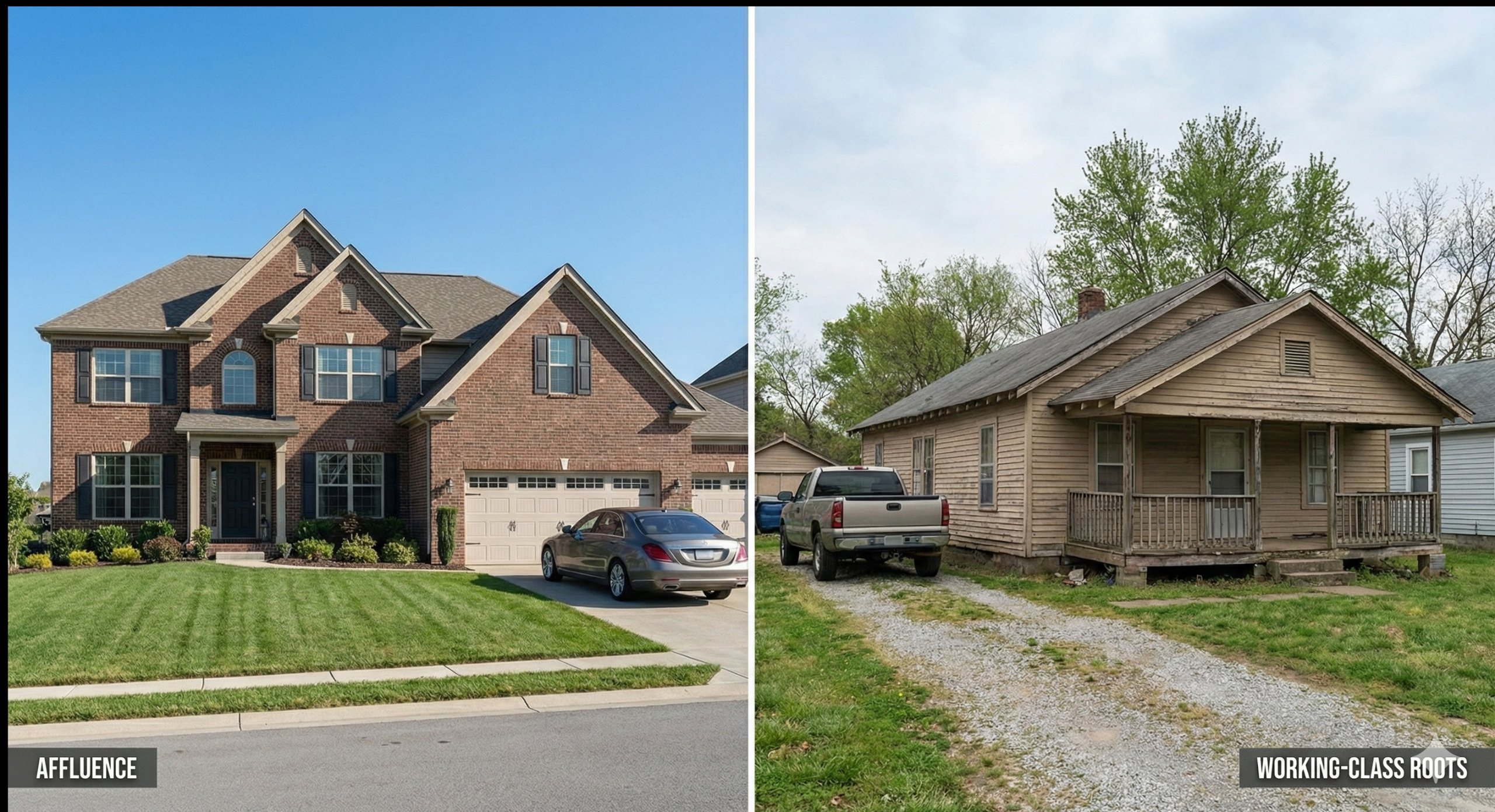
3. It’s a Tale of Two (or More) Economies.Far from being a homogenous economic landscape, Gallatin is a blend of significant financial diversity. The data paints a vivid picture of a community where different economic realities exist side-by-side, a contrast best illustrated not just by income, but by housing itself.On one end of the spectrum are highly affluent residents. This includes segments like the "Savvy Suburbanites," with a median household income of $142,800, and the "Exurbanites," with a median of ****$ 133,800 . These groups are overwhelmingly homeowners ( 90.7% and 85.9% respectively), living in desirable, established single-family homes. On the other end is the "Hometown Heritage" segment, which constitutes 10.1% of local households and has a median household income of just $40,000 . Their living situation is markedly different: 60% of these householders are renters , and they often reside in much older housing, with 59% of their homes built before 1960.These economic differences translate into distinct lifestyles, while "Hometown Heritage" residents favor NASCAR and wrestling, affluent "Exurbanites" are active supporters of the arts and public radio. This contrast between new homeowners and long-term renters, affluence and working-class foundations, creates a complex community fabric that defies any simplistic suburban stereotype.
The Surprising Sign of Financial Health is… Debt?
4. For Many, High Debt Signals Confidence, Not Crisis.The single most dominant consumer segment in Gallatin is "Workday Drive," representing 15.2% of households. These are affluent, family-oriented professionals who have moved to the suburban periphery to find new housing while still commuting to their jobs.Workday Drive is an affluent, family-oriented market with a country flavor. Residents are partial to new housing away from the bustle of the city but close enough to commute to professional job centers.One of the most counter-intuitive findings about this leading group is that they carry a "higher level of debt," specifically first and second mortgages and auto loans. Here, however, it tells a story of ambition, not distress. This debt is a sign of confident investment. In a high-growth area with a Median Estimated Home Value of $443,700 , taking on a mortgage isn't just about building a lifestyle; it's a strategic financial investment in a booming real estate market. This sentiment is shared among the area’s prosperous residents; the affluent "Savvy Suburbanites" are also described as being "not afraid of debt." For these residents, leveraging their assets is a calculated decision rooted in their own economic stability and the community's promising future.
A New Blueprint for the Suburbs
The data from Gallatin's 37066 zip code provides a clear verdict: the classic suburban stereotype is officially outdated. This community is not a monolith but a dynamic mosaic, booming with new residents, blending urban tastes with suburban life, mixing diverse economic classes, and demonstrating financial confidence through investment.Gallatin serves as a powerful example of a new kind of suburb, one that is more complex, diverse, and vibrant than ever before. As more communities like this evolve, it leaves us with a critical question to ponder: what does it mean for our traditional ideas of city versus suburb?
Monique replies personally, no auto-responses, no call center handoff.