
FSBO vs. Hiring a REALTOR® on the Grand Strand: What Homeowners Should Know Before Choosing
FSBO or hiring a REALTOR? A practical seller’s guide for the Grand Strand.

At a Glance
FSBO can make sense in some situations, particularly when the seller already knows the buyer or has a very clear plan for handling the transaction.
The work does not stop at putting a sign in the yard. Pricing, marketing, showings, negotiation, paperwork and deadlines all remain part of the job.
If you are selling in the Grand Strand, state and local details matter. South Carolina and North Carolina have different agency/disclosure frameworks.
The best choice is the one that fits your property, timeline, comfort level and goals, not simply the one that appears cheapest at the beginning.
Selling a home yourself can sound straightforward. Take some pictures, put the property online, wait for a buyer and save the listing fee. On paper, that sounds pretty good. In the real world, there are a few more moving parts, especially around the Grand Strand, where you may be dealing with primary homes, second homes, condos, investment properties, golf communities and buyers coming from outside the area.
So, should you sell FSBO or hire a REALTOR®? There is no one-size-fits-all answer. The better question is what you are comfortable handling yourself and where professional help could protect your time, money or negotiating position.
1. Start with the price, not the commission
One of the biggest FSBO mistakes is thinking the decision starts with what an agent might charge. It really starts with the price you can reasonably expect the market to support.
A homeowner may know what a neighbor paid, what an online estimate says or what they would like to net. None of those automatically tells you what today’s buyers will pay for your particular home. Condition, location, updates, lot characteristics, HOA details, competing listings and recent comparable sales all matter.
For a Grand Strand property, I would also look closely at whether the home competes with new construction, resort inventory, condos or similar properties that may appeal to the same buyer. The right pricing conversation is bigger than picking a number that feels comfortable.
2. Ask yourself how you will reach the right buyers
Exposure is another important difference. A FSBO seller can advertise online, use social media, put up a sign and respond to inquiries. The question is what happens after someone sees the property.
You need a plan for inquiries, showing appointments, buyer questions, screening, follow-up and keeping the property in front of serious prospects. You also need to decide how you will handle buyers who are already working with agents.
That does not mean a REALTOR® has a magic button that guarantees a sale. It means you are paying for a process, a marketing strategy and someone whose job is to stay on top of the transaction while you continue living your life.
3. Negotiation is where the “simple” sale can get complicated
Getting an offer is not the same thing as getting to closing. Price is only one part of an offer. Financing, due diligence, inspections, repairs, concessions, closing dates, contingencies and other terms can change the real value of a deal.
A good seller needs to understand not just what the buyer is offering, but what the entire package means. A higher price with more risk is not necessarily better than a slightly lower price with cleaner terms.
This is one area where having an experienced professional in your corner can be useful. You still make the decisions; the professional helps you understand the choices and negotiate the details.
4. Paperwork and state rules matter
Real estate transactions are not just marketing exercises. There are agency, disclosure, contract and transaction requirements that vary by state.
In South Carolina, the Real Estate Commission explains that consumers can remain customers or enter into a written agency relationship, and that the brokerage must provide a meaningful explanation of agency relationships at the first practical opportunity when there is substantive contact.
North Carolina has its own framework. The North Carolina Real Estate Commission says brokers must provide the “Working With Real Estate Agents” disclosure at first substantial contact with a prospective buyer or seller.
If your property is near the state line, or if you are moving between South Carolina and North Carolina, do not assume the process is identical. Ask questions early and use the current state guidance and appropriate professionals for legal or tax advice.
5. What does the national data say about FSBO?
The latest National Association of REALTORS® Profile of Home Buyers and Sellers provides useful national context, although it is not a Grand Strand-specific market report.
In the 2025 report, FSBO sales represented 5% of sellers, while 91% of sellers used an agent or broker. The report also showed a median sale price of $360,000 for FSBO homes versus $425,000 for agent-assisted homes. NAR notes that the difference is influenced by the types of properties that tend to be sold FSBO, so it should not be read as proof that hiring an agent automatically produces a particular sales price.
The more useful takeaway for a local homeowner is this: selling a home is a business decision. Compare the expected net result, the work involved, the risk you are willing to take and the value you place on having professional guidance.
6. When might FSBO make sense?
FSBO can be reasonable when the circumstances are unusually simple. For example, you may already have a qualified buyer, you may be selling to someone you know, or you may have the time and experience to manage marketing, showings, negotiations and paperwork yourself.
If you go that route, make a checklist before you put the property on the market. Know your target price, decide how you will handle showings, determine what information buyers will need, understand your state’s disclosure and agency rules, and have a plan for reviewing offers and getting to closing.
7. When does hiring a REALTOR® make more sense?
Professional representation may be worth considering when you want help determining market position, reaching buyers, managing showings, negotiating terms, coordinating the transaction or simply having someone keep the process moving.
It can be especially helpful when the property has a lot of variables, a condo with an HOA, an investment property, a golf-community home, land, a second home or a property where multiple buyers may compete for different reasons.
And there is nothing wrong with interviewing more than one REALTOR®. Ask what they would do to position the property, how they would communicate with you, what services are included and how compensation would work. You should understand the agreement before signing it.
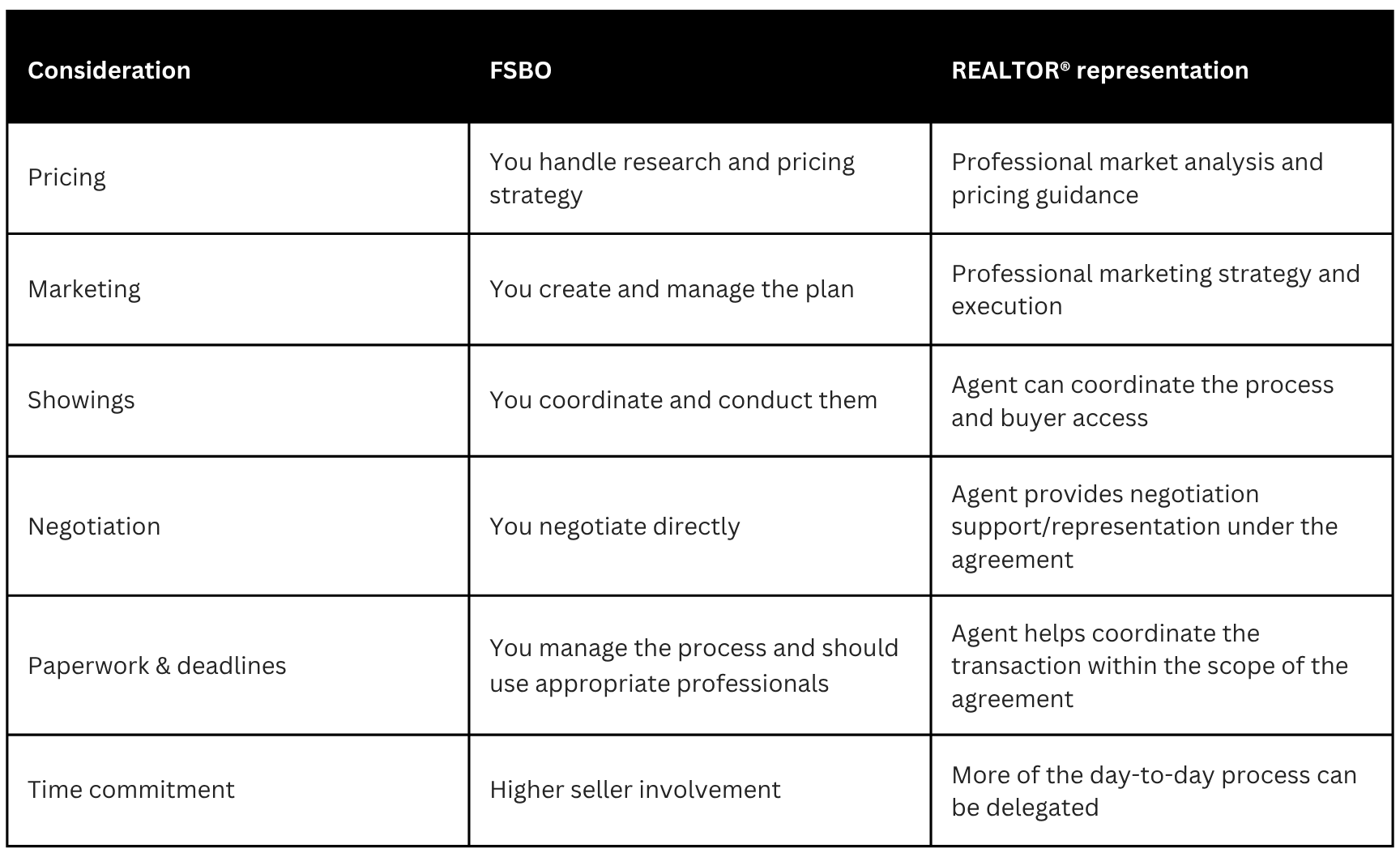
FSBO vs. REALTOR®: A quick comparison
Before You Choose: Seller Checklist
Have I researched recent comparable sales, not just current asking prices?
Do I know my likely net proceeds after all selling costs?
How will I generate and follow up with buyer leads?
How will I handle showings and safety?
Am I comfortable negotiating price, repairs and other terms?
Do I understand the state-specific disclosure and agency requirements?
Do I have the time to manage the transaction from listing through closing?
Would professional representation give me enough value to justify its cost?
Want to see what your home may be worth before deciding? You can request a home value report and use that as one piece of your pricing conversation.
If you are considering selling, buying or simply want to talk through your options, I’m happy to have a no-pressure conversation about the Grand Strand market and your specific situation.
The Bottom Line
FSBO is not automatically a bad idea, and hiring a REALTOR® is not automatically the right answer for every seller. The smart decision is to compare the entire picture: expected price, expected net proceeds, time, marketing, negotiation, paperwork, risk and peace of mind. For a Grand Strand homeowner, the property itself and your goals should drive the decision, not a one-line rule about how homes “should” be sold.
General information only. Real estate, legal, tax and financing requirements can vary by property and circumstance. Consult the appropriate licensed professional for advice specific to your situation.
Dusty replies personally, no auto-responses, no call center handoff.